How to Import G9 Banana from India – Step-by-Step Guide for Buyers
Mar 02, 2026
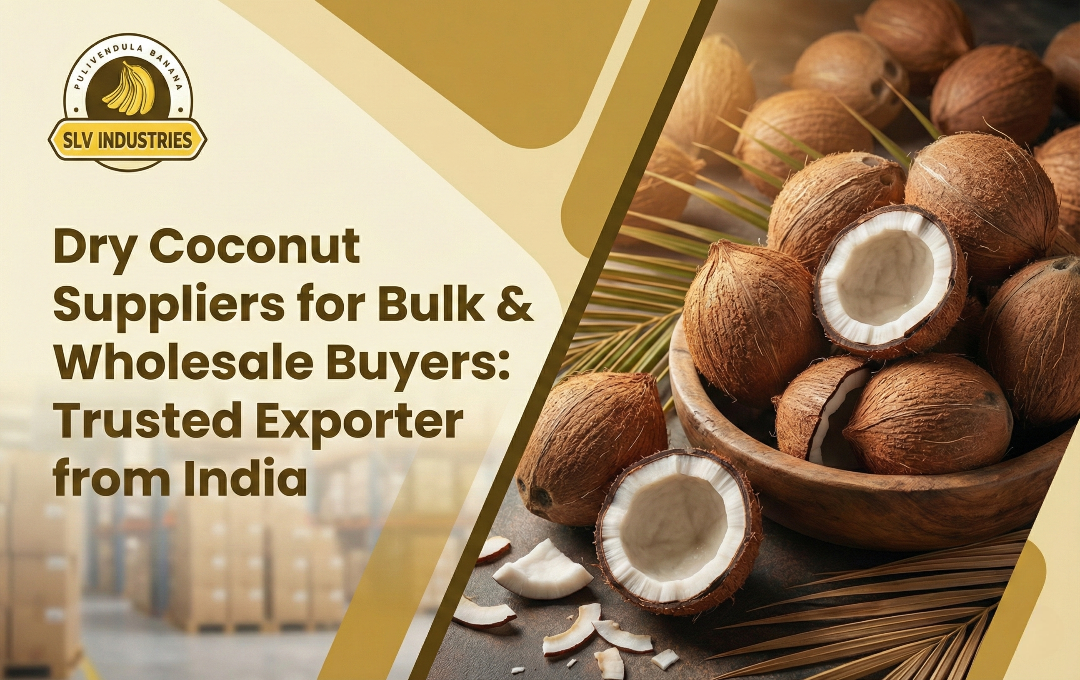
In the global agri-commodity trade, dry coconut remains a high-demand product across edible oil extraction, food manufacturing, confectionery, wholesale distribution, and religious retail markets. For international importers and large-volume buyers, selecting reliable dry coconut suppliers is not just about price; it is about consistency, moisture control, logistics efficiency, and long-term supply stability.
India has emerged as a strategic sourcing destination for bulk coconut procurement due to its strong cultivation base, established processing ecosystem, and export infrastructure.
This article provides a commercially focused overview for buyers actively looking for a bulk dry coconut supplier and structured dry coconut exports from India.
The global coconut products market is projected to reach approximately USD 15.6 billion by 2026, supported by growing demand for plant-based oils, natural ingredients, and coconut-derived food products.
India plays a critical role in this ecosystem. The country produces over 21 billion coconuts annually and contributes roughly 31% of global coconut production, making it one of the top global producers. This scale ensures strong supply continuity for bulk and wholesale buyers.
Primary demand drivers include:
Expansion of coconut oil extraction facilities
Growth in confectionery and bakery production
Increasing demand for desiccated coconut and coconut powder
Rising plant-based and clean-label food trends
For importers, supply stability and quality consistency remain the primary procurement priorities.
Dry coconut refers to fully matured coconuts that are dried to reduce moisture content for long-term storage and industrial processing. The dried kernel is commonly known as copra.
Bulk procurement typically involves:
Ball Copra – Whole dried coconut kernel
Milling Copra – Split and dried kernels for oil extraction
Edible Grade Copra – Cleaned and sorted for food processing
Professional dry coconut suppliers maintain strict quality benchmarks, including:
Moisture Content: Generally 5–6%
High Oil Recovery Percentage
Controlled Free Fatty Acid (FFA) Levels
Uniform Size and Weight
Mold-Free, Clean Appearance
Moisture control is particularly important, as excess moisture can lead to fungal contamination and reduced oil yield.
Export-grade dry coconut undergoes:
Selection of mature coconuts
Dehusking and shell removal
Splitting (if milling grade)
Sun drying or mechanical drying
Sorting and grading
Quality inspection
Bulk packaging and container loading
Proper drying and grading determine both shelf life and commercial value.
India is among the top coconut-producing countries globally. Its production strength supports large-scale dry coconut export from India to international markets.
Tamil Nadu
Karnataka
Kerala
Andhra Pradesh
These regions provide strong raw material availability and structured procurement networks.
Consistent raw coconut supply
Competitive processing costs
Skilled drying and grading units
Access to major southern ports
Ability to load full-container volumes
India’s export ecosystem, supported by agencies such as the Agricultural and Processed Food Products Export Development Authority (APEDA), ensures compliance and documentation readiness for global shipments.
For bulk buyers and wholesalers, evaluating a supplier goes beyond price per metric ton.
A professional bulk dry coconut supplier should provide:
Pre-shipment moisture reports
Oil content consistency
Proper drying methods
Look for:
Clean sorting areas
Proper storage conditions
Structured grading processes
A reliable exporter should manage:
Phytosanitary certification
Certificate of origin
Commercial invoice and packing list
Container fumigation (if required)
Common export packaging includes:
50 kg jute bags
PP woven bags
Custom packaging upon request
A strong supplier should support:
Full 20ft container loads
40ft container volumes
Ongoing monthly shipment contracts
Transactional buyers evaluating dry coconut suppliers typically assess:
Most export-oriented suppliers operate on container-based MOQs. Buyers should confirm:
Minimum shipment size
Trial order flexibility
Typical production and dispatch timelines range between:
7–15 days after order confirmation (depending on volume and season)
Bulk pricing depends on:
Grade and moisture level
Seasonal coconut supply
Container capacity
Freight terms (FOB or CIF)
Transparent pricing and clear communication are critical for long-term sourcing partnerships.
Standard international trade terms may include:
LC (Letter of Credit)
TT (Telegraphic Transfer)
Advance and balance structures
Among export-focused dry coconut suppliers, SLV Industries operates with a structured approach to sourcing, processing, and shipment coordination.
The company procures mature coconuts from established cultivation regions, ensuring:
High oil content
Uniform kernel maturity
Stable raw material availability
SLV Industries emphasizes:
Proper drying practices
Moisture-level checks before dispatch
Systematic grading and sorting
Clean packaging standards
As a bulk dry coconut supplier, SLV Industries supports:
Container-based shipments
Consistent large-volume supply
Customized packaging requirements
Coordinated export documentation
For dry coconut export from India, the company facilitates:
Required compliance documentation
Organized container loading
Timely shipment scheduling
Clear communication with buyers
This export-ready framework helps reduce procurement risks for international importers.
Indian dry coconut is widely exported to:
Middle East countries (strong oil extraction demand)
Southeast Asia (food processing industries)
African markets (growing edible oil consumption)
European regions (plant-based ingredient demand)
Growth drivers include:
Rising coconut oil consumption
Expansion of processed food sectors
Increased demand for natural plant-based ingredients
Growth in private-label repackaging
For wholesalers and processors, securing a stable bulk supply from India offers both cost and availability advantages.
Mitigation:
Pre-dispatch moisture testing
Controlled drying procedures
Mitigation:
Structured grading
Consistent raw material sourcing
Mitigation:
Forward contracts
Transparent pricing communication
Mitigation:
Advance production planning
Organized documentation
Coordinated container booking
Working with experienced dry coconut suppliers significantly reduces operational and financial risk.
India’s scale of production, regional specialization in Ball Copra, established port infrastructure, and export compliance ecosystem make it a strategic sourcing hub for bulk dry coconut supply.
For importers and wholesalers evaluating dry coconut suppliers, commercial success depends on:
Consistent moisture control
Reliable container-based shipments
Transparent pricing structures
Structured export coordination
As a bulk dry coconut supplier, SLV Industries supports international buyers with scalable supply capacity, quality-focused processing, and organized dry coconut export from India.
For buyers planning upcoming procurement cycles, early volume allocation can help secure stable pricing and shipment schedules. Request a quote for upcoming shipments to evaluate current availability and commercial terms.
Most dry coconut suppliers operate on container-based shipments, with a standard minimum order quantity of one 20 ft container. Some exporters may allow smaller trial orders depending on availability and commercial terms.
Export-grade dry coconut typically maintains a moisture level of around 5–6 percent, ensuring longer shelf life, reduced spoilage risk, and optimal oil recovery during processing.
Dry coconut export from India is commonly packed in 50 kg jute or PP woven bags. Packaging may be customized based on buyer requirements and shipping conditions.
Standard export documentation includes a commercial invoice, packing list, phytosanitary certificate, certificate of origin, and bill of lading, depending on destination country regulations.
Pricing depends on grade, moisture content, seasonal supply, order volume, and freight terms such as FOB or CIF. Market fluctuations in raw coconut availability also influence rates.
Production and dispatch generally take 7–15 days after order confirmation, while transit time varies based on the destination port and shipping route.


Lorem ipsum dolor sit amet, consectetur adipiscing elit. Nunc quis ultrices lectus lobortis, dolor et tempus porta, leo mi efficitur ante, in varius felis sem ut mauris. Proin volutpat lorem inorci sed vestibulum tempus. Lorem ipsum dolor sit amet, consectetur adipiscing elit. Aliquam hendrerit.


Received 10% Discount on Your Next Purchase!
By submitting your email you will accept our privacy policy.