How to Import G9 Banana from India – Step-by-Step Guide for Buyers
Mar 02, 2026
One season. Three suppliers. Three very different problems.
The first shipment was delayed because the exporter underestimated port congestion. The second arrived on time—but Brix levels were inconsistent across cartons, triggering complaints from my buyer. The third looked fine at loading, yet residue documentation arrived late, holding containers at destination.
Margins disappeared faster than freight rates spiked.
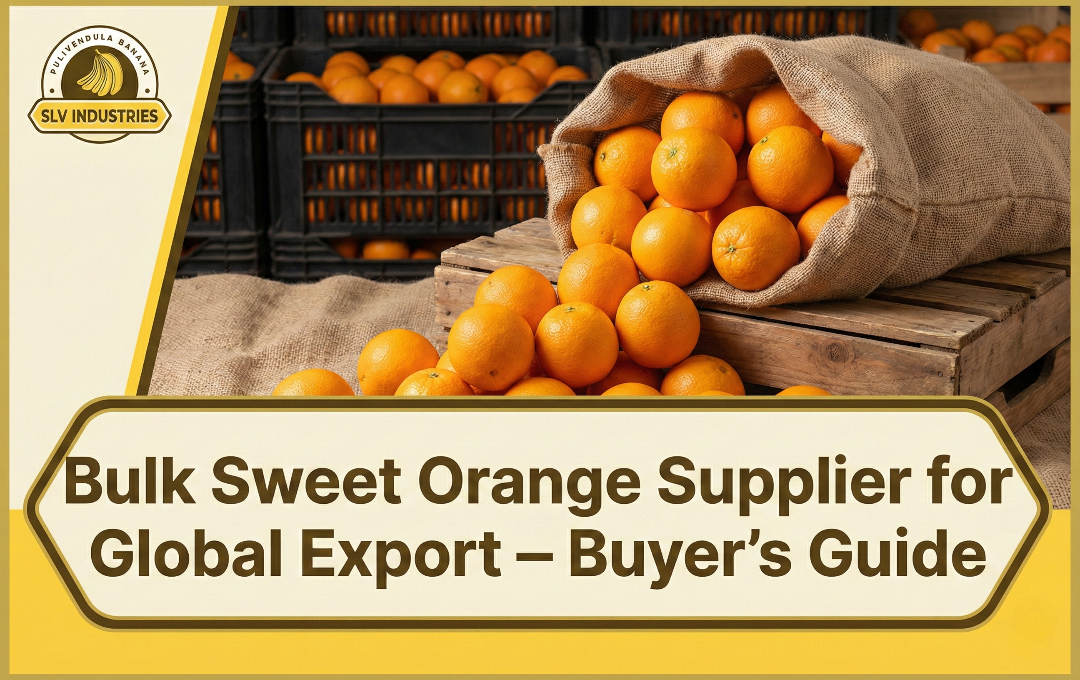
That season changed how I evaluated a Bulk Sweet Orange Supplier. It stopped being about price per carton. It became about supply chain discipline, compliance readiness, seasonal timing, and risk distribution.
And today, that shift is not optional.
Globally, more than 28,300+ orange export shipments move across markets annually. Around 2,637 active exporters supply approximately 1,757 global buyers. Spain leads fresh export value at roughly $1.29B, followed by Egypt at $795M and South Africa at $791M. Meanwhile, climate volatility and citrus greening are reshaping long-term sourcing decisions.
Choosing the right Bulk Sweet Orange Supplier today requires more than scanning FOB quotes. It demands understanding production corridors, freight cycles, compliance ecosystems, and exporter infrastructure maturity.
This guide breaks down global trade dynamics, supplier profiling, pricing frameworks, compliance requirements, risk mitigation strategies, and procurement models that actually protect margins.
Global orange production ranges between 75–80 million metric tons annually, with sweet oranges—Valencia, Navel, Jaffa, and Blood Orange—dominating fresh exports.
Spain commands the premium segment, especially within the EU. Egypt has scaled aggressively with cost-competitive Valencia volumes. South Africa fills European supply gaps during summer months.
The Mediterranean corridor dominates winter supply. South Africa covers summer. Emerging routes into Eastern Europe, Central Asia, and South Asia are expanding demand.
Here’s the reality many buyers overlook: relying on one geographic corridor creates vulnerability. A freight spike in the Mediterranean or a drought cycle in Spain can disrupt procurement overnight.
Export capacity does not equal export reliability. Infrastructure depth, cold-chain integrity, and compliance maturity determine consistency—not raw production figures.
Brazil: Dominates juice processing.
China & India: Large production bases with growing export push.
Egypt & Spain: Fresh export heavyweights.
USA (Florida/California): Impacted by citrus greening (HLB).
Volume alone doesn’t safeguard your contracts. Controlled sourcing systems do.
Heat waves and irregular rainfall cycles affect Mediterranean output. Citrus greening continues to impact Brazil and Florida. Yield variability directly influences FOB pricing and fruit size distribution.
A weak crop year isn’t just lower volume—it shifts size grades and Brix consistency.
Ocean freight volatility reshapes CIF competitiveness overnight. Container shortages during peak harvest compress loading schedules. Port congestion compounds risk.
EU residue standards are tightening. Buyers increasingly demand traceability at farm level. Late documentation can stall clearance.
When residue reports arrive late, containers sit. When containers sit, margins shrink.
Reliable exporters anticipate documentation before buyers request it.
Global orange trade includes 2,637+ active exporters supplying 1,757 buyers worldwide.
Yet only a smaller segment of these companies operate with scalable bulk container programs, structured cold-chain systems, and documentation maturity aligned with international compliance standards.
The suppliers below are positioned based on export scale, infrastructure depth, compliance strength, and active market presence — not merely trading activity.
Egypt: High-Volume, Cost-Competitive Bulk Export Powerhouse
Egypt exports approximately $795M worth of fresh oranges annually, making it one of the most competitive global origins. Its strength lies in winter-season dominance (December–May), large-scale Valencia production, and established EU phytosanitary compliance systems.
Among Egypt’s largest citrus exporters
Strong presence across EU, Gulf, Russia, and Asia
Specializes in bulk Valencia and Navel shipments
Established EU regulatory compliance
Buyer Fit:
Well suited for importers requiring steady weekly container volumes during peak season.
Grower-exporter structure
Advanced grading and packing facilities
Structured cold storage systems
Supplies European retail and wholesale chains
Positioning:
Relevant for structured retail buyers prioritizing grading precision and cold-chain consistency.
Farm-focused sourcing approach
Custom grading and packaging capabilities
Strong presence in Middle East and European markets
Relevance:
Appropriate for buyers seeking packaging flexibility or private label programs.
Farm-to-port logistics coordination
Focus on Valencia and Navel exports
Offers private labeling options
Efficient export documentation handling
Commercial Context:
Integrated logistics reduce handling delays during high-volume harvest periods.
Known for high-Brix Navel oranges
Strong Class-1 export grading
Focused on EU and Asian markets
Maintains structured cold-chain systems
Buyer Consideration:
High-Brix orientation makes it suitable for premium fresh fruit retail segments.
Spain leads global fresh orange exports at approximately $1.29B annually. Its competitive advantage is rooted in:
Proximity to EU retail markets
Advanced logistics infrastructure
Strong quality perception
Spanish exporters typically operate within structured retail supply chains and command premium FOB pricing, supported by shorter transit times within Europe.
Best For:
Supermarket programs, private label retail chains, and premium distributors.
Turkey’s export window (November–April) overlaps Mediterranean harvest cycles and supports strong pricing competitiveness.
Turkish citrus exporters offer:
Valencia, Washington Navel, and Jaffa varieties
Strong presence in Russia and CIS markets
Seasonal advantage during autumn–winter
Strategic Use Case:
Appropriate for price-sensitive wholesale markets in Eastern Europe and CIS regions.
India, the Philippines, and Nepal are strengthening their export positioning, particularly in Gulf and regional Asian markets.
Supplies sweet oranges and Kinnow varieties
Growing exports toward Southeast Asia and Middle East
Focused on competitive bulk shipments
Market Fit:
Suitable for buyers diversifying away from Mediterranean sourcing.
Exports Nagpur and sweet orange varieties
Handles export documentation and logistics coordination
Expanding Gulf market presence
Operational Strength:
Structured documentation processes support smoother import clearance.
B2B citrus sourcing model
Distribution strength within Southeast Asia
Positioned for regional wholesale buyers
Ideal For:
Buyers sourcing within ASEAN trade corridors.
Competitive bulk citrus positioning
Focused on regional Asian markets
Cost-sensitive wholesale structure
Relevance:
Suitable for smaller-volume importers prioritizing pricing efficiency.
Headquartered in Kadapa, Andhra Pradesh
Operates through direct farmer networks
Exports sweet oranges and citric oranges in bulk formats
Manages procurement, grading, packaging, and export documentation
FSSAI-certified processing facilities
Positioning:
Aligned with importers and distributors seeking structured sourcing from India during the December–March harvest cycle.
Instead of evaluating on price alone, buyers should assess:
Farm integration level (direct sourcing vs intermediary trading)
Cold-chain infrastructure capacity
EU residue compliance track record
Weekly container loading capability
Documentation turnaround efficiency
Packaging and private label flexibility
Alignment with seasonal import cycles
Understanding seasonal windows prevents supply gaps.
Egypt: December to May
Turkey: November to April
Spain: November to June
South Africa: June to October
India: December to March
Diversifying between Mediterranean winter suppliers and Southern Hemisphere summer exporters reduces risk exposure.
Smart buyers stagger contracts across hemispheres.
FOB pricing is influenced by:
Brix level (sugar content)
Size grade (56–113 standard carton count)
Packaging type (10kg vs 15kg cartons)
Destination compliance requirements
Peak vs off-peak season
Freight rates
Market positioning by country
Country positioning typically trends:
Egypt: Highly competitive
Spain: Premium
Turkey: Competitive
South Africa: Mid-to-premium
India: Competitive regional exporter
The cheapest FOB is rarely the cheapest landed cost. Rejections erase savings.
A dependable Bulk Sweet Orange Supplier protects consistency across size grading and sugar levels—not just pricing.
Mandatory certifications include:
GlobalG.A.P
HACCP
ISO 22000
FSSAI (India-specific)
Phytosanitary Certificate
Certificate of Origin
Residue testing reports
If a Bulk Sweet Orange Supplier cannot proactively provide documentation samples during negotiation, consider that a warning sign.
Export maturity reveals itself in paperwork speed.
Before signing contracts, ask:
Do they control farms or source through intermediaries?
Cold storage capacity?
Grading and packing automation level?
Weekly container loading capacity?
Private label customization capabilities?
Integrated exporters reduce quality inconsistency.
SLV Industries exemplifies this model. With controlled procurement from direct farmer networks and in-house processing aligned to export standards, documentation, grading, and compliance are managed under one system. For importers seeking operational predictability, infrastructure depth often matters more than aggressive pricing.
Several forces are reshaping trade:
Surge in demand for residue-compliant citrus in the EU
Increased traceability requirements
Growth in private label citrus branding
Diversified sourcing due to disease risk
Rising demand in CIS and Middle East markets
The future favors suppliers with farm-level transparency and controlled sourcing—not just volume players.
Over 60% of global fresh orange exports are concentrated among five exporting countries.
Citrus greening has reduced Florida’s orange production by more than 70% over two decades.
Mediterranean exporters dominate winter supply windows, creating seasonal price peaks.
Private label citrus programs are expanding across European retail chains.
Brix variations of just 1–1.5 points can influence buyer acceptance in premium markets.
Focus on:
Cold-chain reliability
Volume stability
Compliance history
Prioritize:
Consistent grading
Packaging customization
Residue compliance
Evaluate:
Brix consistency
Bulk contract stability
Crop predictability
A Gulf distributor may prioritize price stability. An EU retailer prioritizes residue compliance above all.
Different models demand different supplier strengths.
Diversify geography (Mediterranean + Southern Hemisphere)
Lock contracts early during peak harvest
Evaluate exporter responsiveness
Audit documentation efficiency
Assess logistics partnerships
The strongest buyers build long-term relationships with scalable exporters rather than chasing short-term discounts.
Global orange trade continues to expand, with more than 28,300 shipments moving annually across highly competitive corridors. But growth does not automatically translate into stability. Climate variability, tightening residue regulations, shifting freight economics, and disease pressure are steadily redefining margin structures.
Egypt remains a cost-competitive volume leader. Spain and South Africa hold premium positioning in structured retail markets. India is strengthening its presence, particularly through exporters investing in farm integration and compliance-driven infrastructure.
In this environment, risk diversification is no longer a strategic advantage — it is a baseline requirement.
Selecting a Bulk Sweet Orange Supplier today is less about securing the lowest FOB and more about building a sourcing framework that absorbs volatility. Infrastructure depth, documentation responsiveness, grading consistency, cold-chain integrity, and seasonal alignment now determine long-term viability.
Exporters operating through direct farmer networks, certified facilities, and structured export systems offer greater supply predictability than intermediary-driven trading models. The difference often becomes visible only during disruption — when documentation must be issued quickly, containers must load on schedule, or compliance questions arise at destination.
For buyers evaluating sourcing options from India, companies such as SLV Industries reflect this integrated approach — combining farm-level procurement networks, certified processing environments, and coordinated export handling within a single operational structure.
In citrus trade, consistency builds reputation. Inconsistency compounds losses.
The buyers who treat sourcing as a strategic ecosystem rather than a transactional purchase are the ones who protect margins over time.
If you are evaluating long-term sweet orange sourcing from India and want structured supply backed by integrated farm networks, certified handling, and export-ready documentation, connect directly with our team.
We work with bulk buyers who prioritize continuity, compliance, and operational clarity over short-term price fluctuations. Let’s discuss your volume requirements, seasonal alignment, and destination specifications to build a sourcing framework that protects your margins.
👉 Speak with our export team today and secure your next shipment with confidence.
Global production averages 75–80 million metric tons per year, but only a fraction of that volume enters the fresh export market. Domestic consumption in major producing countries like China and Brazil absorbs significant output. For buyers, the more relevant metric is export-grade availability — fruit that meets size, residue, and cosmetic standards for international retail or distribution.
Spain leads global fresh exports at roughly $1.29 billion, supported by strong EU retail integration and advanced logistics networks. Egypt and South Africa follow closely, each serving different seasonal and pricing niches. The “largest exporter” isn’t always the best fit — the right origin depends on destination market, compliance expectations, and timing.
A dependable Bulk Sweet Orange Supplier should offer GlobalG.A.P, HACCP, ISO 22000 (or equivalent), phytosanitary certification, certificate of origin, and updated pesticide residue analysis reports. Beyond possessing certificates, suppliers should demonstrate documentation speed and transparency. Delayed paperwork is one of the most underestimated causes of port demurrage and margin erosion.
Most exporters operate on a full container load (FCL) basis, typically 20ft or 40ft reefer containers. A 40ft reefer can hold approximately 20–25 metric tons depending on packaging configuration. Smaller buyers may negotiate shared containers, but this requires strong coordination and may increase per-unit logistics costs.
Common structures include:
Letter of Credit (LC) at sight
30% advance with 70% against Bill of Lading
Documents against Payment (DP)
New supplier relationships often start conservatively with LCs until mutual trust is established. Buyers should align payment structure with risk appetite and supplier credibility.
Under controlled reefer conditions (typically 3–8°C depending on variety), sweet oranges can maintain commercial quality for 30–45 days. Shelf life depends heavily on pre-cooling efficiency, humidity control, and post-harvest handling. Poor cold-chain management shortens marketable life dramatically.
Pre-shipment inspection may involve third-party agencies or buyer-appointed inspectors verifying:
Size grading accuracy
Brix levels
External defects
Packaging compliance
Palletization standards
Professional exporters often share loading photos, video documentation, and container temperature settings before vessel departure to reduce disputes.
Most contracts reference Incoterms (FOB, CIF, CFR) and specify arbitration jurisdiction. Disputes commonly involve quality variance or transit damage. Clear photographic evidence at loading, detailed packing lists, and timely communication significantly reduce conflict escalation.
Work with exporters who implement farm-level residue monitoring programs and maintain consistent pesticide application records. Suppliers operating through integrated farmer networks with controlled procurement systems generally offer better traceability than intermediated trading models.
Spot purchasing may deliver short-term price advantages, but long-term partnerships provide crop allocation priority, stable size grading, flexible payment terms, and predictable loading schedules. In volatile seasons, exporters prioritize committed buyers.

Lorem ipsum dolor sit amet, consectetur adipiscing elit. Nunc quis ultrices lectus lobortis, dolor et tempus porta, leo mi efficitur ante, in varius felis sem ut mauris. Proin volutpat lorem inorci sed vestibulum tempus. Lorem ipsum dolor sit amet, consectetur adipiscing elit. Aliquam hendrerit.


Received 10% Discount on Your Next Purchase!
By submitting your email you will accept our privacy policy.