How to Import G9 Banana from India – Step-by-Step Guide for Buyers
Mar 02, 2026
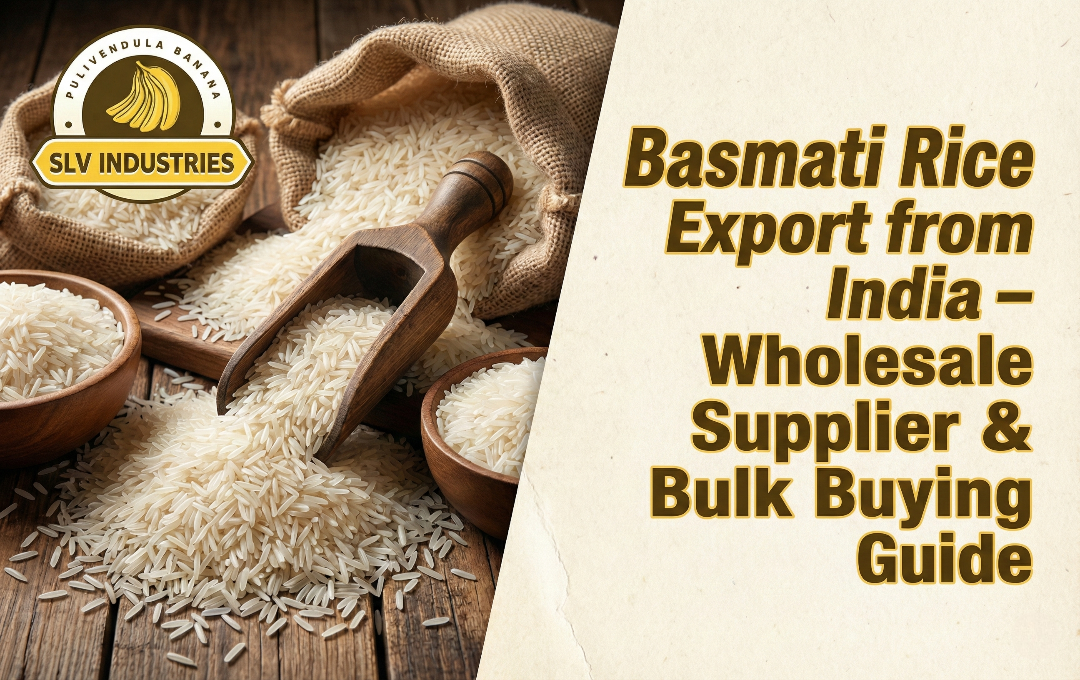
A Middle Eastern importer once put it bluntly during a procurement call:
“The aroma is perfect. The grain length is excellent. But how do I know the next shipment will match this one?”
That question captures the new reality of basmati rice export from India. It’s no longer just about fragrance or elongation ratio. It’s about consistency, documentation, price stability, freight timing, and long-term supply reliability.
And the numbers prove how big this ecosystem really is.
In FY 2024–25, India exported approximately 6.065 million metric tonnes (MT) of basmati rice, reaching an export value of nearly ₹50,312 crore (~$5.87 billion). That’s a volume growth of around 15.7% year-on-year, with calendar 2025 exports touching nearly 6.4 million tonnes.
India controls roughly 70–87% of global basmati trade, making it the undisputed leader in the segment.
Why this matters now:
Global premium rice demand is rising
Middle East consumption continues expanding
Organic and aged basmati are growing ~15% annually
Supply chain transparency has become non-negotiable
If you’re evaluating wholesale basmati rice procurement, this isn’t just a commodity decision. It’s a strategic sourcing move.
This guide breaks down how bulk buyers and importers can navigate sourcing from India intelligently.
India is the world’s #1 basmati exporter, shipping to over 150 countries.
Its dominance in basmati rice international trade isn’t accidental. It’s built on decades of agricultural refinement in the basmati belt spanning Punjab, Haryana, Uttar Pradesh, Uttarakhand, and Jammu & Kashmir.
Compared to competitors, especially Pakistan (which holds roughly 35% share in the basmati segment), India operates at a scale that provides:
Supply consistency
Wider variety options
Advanced milling ecosystems
Stronger export infrastructure
Most global Indian basmati rice suppliers are integrated into a mature value chain — from farm-level aggregation to modern milling and containerized export.
In procurement cycles, buyers rarely shift origins unless forced by policy or severe pricing shocks. India’s consistency keeps importers anchored.
Smart buyers monitor India–Pakistan production forecasts annually before locking long-term contracts.
The quality of premium long-grain rice starts in the soil.
The basmati belt benefits from:
Unique alluvial soil
Controlled irrigation systems
Climatic conditions that enhance aroma compounds
Traditional cultivation methods combined with modern agronomy have strengthened yield predictability without compromising grain integrity.
Post-harvest processes matter just as much.
Modern mills use:
Advanced grading systems
Optical sorting
Controlled aging chambers
Aged basmati commands higher premiums because controlled storage enhances aroma and cooking elongation. Organic basmati, growing at ~15% annually, is also gaining traction.
Here’s an industry reality:
In bulk contracts, aroma retention after 30–45 days of shipment often separates reliable bulk basmati rice exporters from opportunistic traders.
When it comes to basmati rice export from India, the Middle East isn’t just another region — it’s the backbone of global demand.
Major importers include:
Saudi Arabia (~1.17 million MT)
Iraq (~0.90 million MT)
Iran (~0.855 million MT)
UAE (~0.389 million MT)
These numbers aren’t incidental. In many GCC countries, basmati is not a premium add-on — it is a dietary staple. It sits at the center of traditional cuisine, from mandi and biryani to institutional catering.
Why the Middle East dominates:
Strong per-capita rice consumption
Heavy reliance on imports due to limited domestic production
Government tenders and institutional buying programs
High HORECA (Hotels, Restaurants, Catering) demand
Government procurement cycles in Iraq and Iran, for example, can move hundreds of thousands of metric tonnes in a single tender window. That kind of scale drives stability for wholesale basmati rice exporters.
For GCC markets, the priority is clear:
Price competitiveness at scale + consistent grain quality.
Margins are often thin, volumes are high, and repeat contracts depend on shipment reliability.
The United States (~0.274M MT) and the United Kingdom remain significant importers — but their buying logic is different.
These markets focus less on sheer tonnage and more on:
Organic certification
Clean-label positioning
Retail-ready packaging
Strict traceability documentation
In the U.S. and UK, basmati is often sold in branded, value-added formats. Packaging aesthetics, labeling compliance, and residue testing standards matter as much as grain length.
Observation from the field:
Middle East drives volume.
USA and UK drive premiumization.
Importers targeting Western markets must think beyond commodity pricing. Compliance failures in these regions result in container rejections, penalties, and brand damage.
The average export price of Indian basmati in 2023–24 hovered around $1,105 per metric tonne. Despite geopolitical tensions and freight fluctuations, FY 2024–25 recorded approximately 3.97% year-on-year value growth.
This suggests structural price resilience.
Why?
Because global demand for premium long-grain rice continues to expand faster than supply volatility can suppress it.
However, wholesale pricing is never static.
Paddy Procurement Costs
Farm-gate prices fluctuate depending on harvest size, monsoon performance, and MSP (Minimum Support Price) policies.
Export Policy Shifts (MEP & Restrictions)
Minimum Export Price (MEP) regulations can temporarily increase international pricing floors. Even rumors of policy changes affect forward contracts.
Freight & Logistics Costs
Ocean freight rates — especially during geopolitical tensions — can add $50–$150 per MT unpredictably.
Currency Volatility
USD-INR exchange rate shifts directly influence export competitiveness.
Geopolitical Tensions
Middle East instability, Red Sea disruptions, or sanctions regimes can alter routing and insurance costs.
Strategic buyers don’t just negotiate FOB rates.
They include price-adjustment clauses in long-term contracts to absorb volatility intelligently.
The backbone of basmati rice export from India lies in variety specialization:
1121 Basmati – Extra-long grain, superior elongation (often 2x length after cooking), widely preferred in GCC markets
1509 Basmati – Competitive pricing, shorter cultivation cycle, strong export favorite
1718 Basmati – Balanced yield and grain length
Pusa variants – Improved agronomic performance
Organic & aged basmati – Fast-growing premium segments
Grain benchmarks typically include:
Length exceeding 8.3 mm (pre-cooking)
Elongation ratio between 1.8–2.2x
Broken grain tolerance from 1–5% depending on buyer specification
Experienced importers always specify moisture percentage and foreign matter tolerance in contracts to avoid disputes at destination.
Bulk shipments are commonly packed in:
25kg or 50kg polypropylene (PP) woven bags
Private-label branded packaging
20ft or 40ft containerized shipments
Regional differences matter:
African markets prioritize cost-efficient bulk packaging.
EU buyers require strict labeling rules including country-of-origin marking, batch traceability, and sometimes allergen disclosures.
Incorrect labeling can result in customs detention — even when the product quality is perfect.
In 2022–23, non-basmati export curbs shook broader rice markets. Although basmati trade remained comparatively stable, policy uncertainty impacts sentiment and forward pricing.
By 2025, most restrictions eased, restoring competitiveness. However, MEP policies can reappear during domestic supply pressures.
Serious buyers monitor Indian Ministry of Commerce announcements before finalizing large-volume contracts.
Many buyers see certifications as a formality. They’re not.
Here’s what each certification actually protects you against:
APEDA Registration
Confirms the exporter is registered with the Agricultural and Processed Food Products Export Development Authority. Essential for legitimate agricultural exports from India.
AGMARK Certification
Government-backed quality grading standard. Ensures product meets specific purity and quality benchmarks.
ISO Certification
Indicates standardized quality management systems in processing and packaging facilities.
Phytosanitary Certificate
Confirms the shipment is free from pests and meets the importing country’s plant health standards. Mandatory in most international trade.
FSSAI Compliance
Ensures food safety standards within India’s regulatory framework.
Destination-Country Import Compliance
May include FDA (USA), EU food safety directives, or GCC conformity standards.
Skipping documentation verification often leads to container detention, demurrage charges, and margin erosion.
Pakistan competes strongly in aromatic profile but operates at smaller export scale.
Thailand and Vietnam dominate non-basmati rice segments but are not primary players in basmati.
India’s advantages:
Volume scalability
Multiple variety options
Advanced milling infrastructure
Strong export ecosystem
Some importers hedge risk with dual-origin sourcing. However, for sustained, high-volume contracts, Indian suppliers remain structurally dominant.
Major export ports include:
Kandla
Mundra
Nhava Sheva
Typical transit times:
Middle East: 7–14 days
USA: 25–35 days
Freight volatility, vessel space shortages, and port congestion can delay shipments. Experienced exporters diversify freight partnerships and book slots in advance during peak harvest seasons.
Bulk sourcing carries real risks:
Climate-driven yield fluctuations
Export policy shifts
Freight spikes
Quality mismatch at destination
A buyer once admitted:
“We chose the lowest FOB offer. The grain failed elongation standards. We paid for re-sorting and lost retail shelf space.”
Price is visible.
Quality failures are expensive.
Years of export experience
Proven shipment track record
Grain consistency benchmarks
Transparent traceability systems
Supervised container loading processes
Compare FOB vs CIF structures carefully
Lock contracts during harvest season for better pricing
Secure volume discounts for long-term supply
The smartest buyers review documentation history and quality claims before negotiating discounts.
Organic basmati growing approximately 15% annually.
Aged rice demand expanding significantly in EU and North America.
Retail-ready exports rising as importers build their own brands.
Africa expanding consumption.
Southeast Asia gaining traction.
Australia steady.
Export volumes are projected to reach new highs by 2026–27, driven by sustained demand and expanding middle-class consumption globally.
India’s agro-climatic conditions, processing ecosystem, and export infrastructure enable it to control 70–87% of global basmati trade.
Typically container-load quantities (20ft or 40ft). Smaller volumes may incur higher per-unit costs.
Average prices hover around $1,105 per MT but fluctuate based on policy, harvest output, freight, and currency.
Yes. Organic and premium-aged basmati segments are expanding at approximately 15% annually, especially in Western markets.
India exported over 6 million metric tonnes of basmati last year, valued near $6 billion. It controls the majority of global trade and continues expanding into new markets while strengthening premium and organic segments.
For bulk buyers targeting the Middle East, Europe, or North America, India remains structurally dominant.
But dominance alone isn’t enough.
Successful sourcing depends on:
Supplier vetting
Transparent pricing structures
Documentation compliance
Grain consistency
Freight coordination
Long-term reliability
In today’s environment, importers aren’t just looking for exporters. They’re looking for partners who understand procurement pressure, regulatory scrutiny, and margin sensitivity.
There are multiple names but companies like SLV Industries operate from one of India’s strongest agricultural regions and maintain a direct farmer network that ensures stable sourcing, consistent grading, and export-ready documentation. With controlled supply chains, certified processing facilities, and structured logistics oversight, the company supports global buyers seeking predictable, compliant, and scalable wholesale basmati rice sourcing from India.
If you’re evaluating basmati rice export from India for bulk procurement, start with exporters who combine production depth, documentation transparency, and shipment discipline. The right sourcing decision today can define your market competitiveness for years to come. Contact SLV Industries to learn more!


Lorem ipsum dolor sit amet, consectetur adipiscing elit. Nunc quis ultrices lectus lobortis, dolor et tempus porta, leo mi efficitur ante, in varius felis sem ut mauris. Proin volutpat lorem inorci sed vestibulum tempus. Lorem ipsum dolor sit amet, consectetur adipiscing elit. Aliquam hendrerit.


Received 10% Discount on Your Next Purchase!
By submitting your email you will accept our privacy policy.